
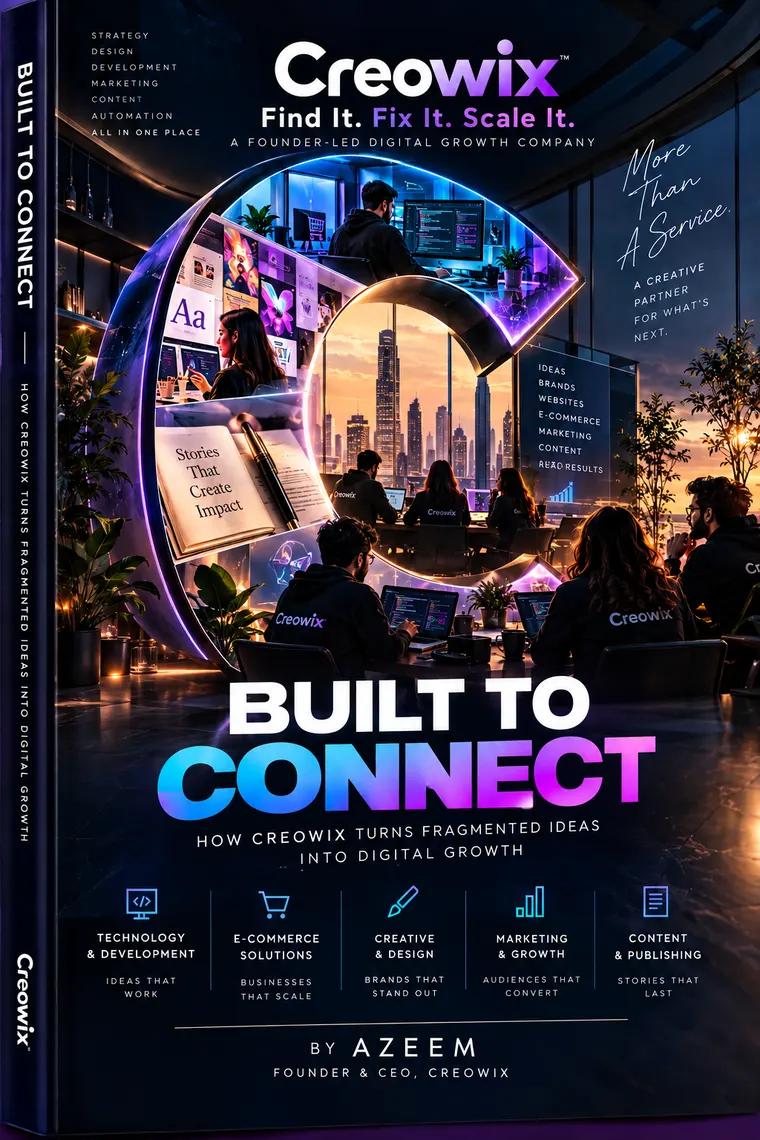
Before you start
A note before you start
This book is not a brochure. I didn't write it to list our prices or to tell you we're the best agency in America. I wrote it because I keep having the same conversation with business owners, and I wanted to put that conversation somewhere you can read it at your own pace, with a coffee, without anyone trying to sell you anything.
Everything in here is how we actually think and work. The stories in Part Three are real projects. I've left out the names of the businesses, because their numbers and their struggles are theirs to share, not mine. When I want you to imagine a situation instead, I'll say so. I'd rather you trust this book a little more than be impressed by it a little faster.
Read it front to back, or jump to the chapter that sounds like your week. Either way, by the last page you'll know exactly who we are, and you'll probably see your own business a little more clearly too.
“Your business already has a story. My job is to make every part of it tell the same one.”
Opening
A letter from me to you
Let me start with something you probably already know, but rarely hear anyone say out loud.
You are working harder than ever. You answer messages at night. You post on social media when you remember to. You fix the website when something breaks, or you pay someone to fix it, and then you pay them again next month for the next small change. You have a product or a service you're genuinely proud of. And still, the growth you were expecting just… isn't showing up the way it should.
If that's you, I want you to hear this first: it's not because you're doing something wrong. It's not because you're lazy, or behind, or not smart enough for the internet. It's because nobody ever sat down with you and looked at the whole picture.
Most businesses are built in pieces. One person made the logo years ago. Someone else built the website. A nephew set up the Instagram. An agency runs the ads. Each piece was done by someone who only saw their piece. So the pieces don't talk to each other, and you end up being the glue holding it all together, with your own hours.
That's the problem I started Creowix to solve. Not to be one more vendor on your list, but to be the one team that sees everything, connects everything, and then stays with you while it grows.

In this book I'll tell you how we think, why we built the company around five pillars, what we actually do inside each one, and what happened when we worked this way with real businesses. And I'll tell you what we believe about partnership, because that part matters to me more than any service on our list.
Thank you for opening this. Let's get into it.
— Azeem
Part One · Why we exist
Chapter 1
The Ceiling
Every business hits one. The number is different. The feeling is the same.
Every business hits a ceiling at some point. For some it shows up at their first good month. For others it shows up much later, after years of growth, when the business is already bigger than most people would ever dream of. The number on the chart is different for everyone. The feeling is exactly the same.
You're doing more than ever, and the line has gone flat.
You add more hours. You try a new platform. You run a promotion. Maybe you hire someone. For a little while things move, and then they settle right back at the same level, like there's a glass roof over the business that you can't see but you can definitely feel.
Why you can't see it from the inside
Here's the thing about a ceiling: from the inside, it looks like the sky. When you're running the business every day, you're too close to it. You're handling orders, customers, staff, suppliers, taxes. You don't have the distance to notice that your website loses people on the second click, or that your best customers can't find you on Google, or that your social media is talking to the wrong crowd.
It's like a leak in a boat. You don't see the hole. You just notice you're bailing water faster and faster to stay in the same place.

What a ceiling is usually made of
After a lot of conversations with owners, I've noticed the ceiling is almost never one big thing. It's a handful of small things, stacked on top of each other:
- A website that looks fine but doesn't turn visitors into calls, bookings or sales.
- A brand that looks smaller than the business really is, so bigger clients don't take it seriously.
- Marketing that brings people in, but to a place that isn't ready for them.
- Hours of the owner's week going into tasks a system could do.
- A great story nobody is telling, so the business sounds like everyone else.
None of these alone would stop a business. Together, they form that glass roof. And because each one lives in a different department, no single vendor ever sees the full shape of it.

Chapter 3
Why I built Creowix
One team, one conversation, one direction.
My background is in sales, business development and operations. I spent years on the side of the table where you have to understand what a business actually needs before you can help it. You learn quickly that people don't buy websites, or logos, or ads. They buy the result those things are supposed to bring.
And I kept seeing the same frustrating pattern. A growing company would have to explain its whole business five different times to five different vendors. The web developer didn't know what the marketing team promised. The designer never spoke to the person writing the content. The ads pointed at pages that weren't built for them. Everyone did their part, and nobody owned the result.
“Why should a business owner have to be the project manager of their own growth?”
That question is where Creowix came from. I wanted to build the opposite experience: one team that starts with your goal, not with a deliverable. The first conversation isn't “what kind of website do you want?” It's “what does this business need to achieve, and what's standing in the way?”
What “founder-led” really means
Founder-led isn't a slogan for us. It means I'm personally in the strategy of every client we take on. I'm the one who sits with you, listens to how your business works, finds the leak, and puts together the plan. My team builds it with me, and I stay close to it the whole way, because the plan is only as good as the understanding behind it.
It also means we're small enough to care and experienced enough to deliver. You won't be passed from a salesperson to an account manager to a junior designer who's never heard your name. You'll be talking to the people doing the work.

Part Two · How we think
Chapter 4
Find it. Fix it. Scale it.
Three words that shape everything we do.
If you remember one thing from this book, remember these three words. They're our tagline, but more than that, they're the order we do things in. And the order is the whole secret.
Find it
Before anyone designs or codes a single thing, we find the real problem. Not the symptom you called us about, the cause underneath it.
Someone might come to us saying “we need a new website.” Maybe they do. But very often the website is fine, and the real problem is that nobody can find it, or that it's talking to the wrong customer, or that the business can't update it without paying someone every time. If we just built a prettier website, we'd have taken your money and left the real problem exactly where it was.
So we look at everything: your website, your brand, your online presence, your marketing, your content, your systems, and most importantly, how your business actually makes money. We ask a lot of questions. We listen more than we talk.
Fix it — in the right order
This is the part most people get wrong. When a business has several problems, fixing them in the wrong order wastes money. Running ads to a website that doesn't convert just pays to show more people a leaky bucket. Posting more on social media with a brand that looks cheap just spreads the cheap look further.
Real problems are rarely simple. Sometimes it's complex, and we have to make sure every angle is clear before we move. So we build a plan that says: this gets fixed first, then this, then this, and here's why. Each fix makes the next one work better. That's the difference between patching things and actually solving them.

Scale it
Once the foundation is solid, growth stops being a fight. Now marketing brings people into a place that's ready for them. Now your brand makes bigger clients take you seriously. Now your systems handle the extra orders without eating your evenings. This is where revenue moves, where the brand grows, and where the business starts reaching the next tier instead of bumping into the same ceiling.
And then, honestly, a new challenge shows up. It always does, because growing businesses meet new problems. That's fine. We find it, fix it, and scale again. It's a cycle, not a one-time project.
Chapter 5
The Five Pillars
Why a brand needs a strong base on every side.
Picture a building. Not a tent, a real building, the kind that's still standing in fifty years. What holds it up? Pillars. Several of them, spread out, each one carrying part of the weight. Take one away and the building doesn't fall immediately, but it starts to lean. Take two away and you don't want to be inside.
A business online works exactly the same way. We built Creowix around five pillars, because after years of watching businesses grow and stall, these are the five things every brand stands on:
Technology & Development
The engine: websites, apps, software and automation that make your business run smoothly.
E-commerce
The storefront: how you sell online, from Shopify to Amazon, and how easy it is for people to buy.
Creative & Design
The face: your logo, your look, your brand, the first impression people judge you on.
Marketing & Growth
The voice: how people find you, from Google and AI search to social media, ads and email.
Content & Publishing
The story: the words that make people trust you, from your website copy to blogs and books.

Why all five, and why together
Here's what happens when one pillar is weak. A beautiful brand with no marketing is a secret. Great marketing with a slow website is money poured into a hole. A strong store with a weak story becomes easy to replace with a cheaper competitor. Brilliant content on a site nobody can find never gets read.
Every pillar makes the others stronger. That's why we keep all five under one roof, with one team that talks to each other every day. When your designer, your developer, your marketer and your writer are the same team, working from the same plan, your business finally tells one consistent story everywhere.
You don't need everything at once
I want to be very clear about this: having five pillars doesn't mean we'll try to sell you all five. Some businesses need one pillar fixed urgently and the others are already fine. A disciplined team also knows what not to recommend. Sometimes the branding has to come before the advertising. Sometimes the process has to be fixed before we automate it. The plan decides, not our service list.
But whatever you start with, you'll have a team that can support you on every front when you're ready. You want development? We have a pillar for that. Design? A pillar for that. Social media, content, a store? Same. You never have to start over with a new vendor who doesn't know your business.
Pillar 1
Technology & Development
The engine under the hood.
Your website is often the first place a customer meets you and the last place they decide whether to trust you. Behind it, your technology decides how much of your day goes into running things by hand.
Good technology is almost invisible. The page loads fast on a phone. The booking works the first time. The order lands where it should. You change a price or a photo yourself in two minutes, without calling anyone. That's what we build: systems that quietly do their job so you can do yours.
What's inside this pillar
- Web development: fast, secure, modern websites built to grow with you, not be rebuilt every two years.
- Mobile app development: apps for iPhone and Android, built for real-world use.
- Custom software: tools shaped around the way your business actually works.
- Shopify and e-commerce development: stores built to sell, with the features you need.
- AI automation: letting software handle the repetitive work, like instant replies, lead routing, reminders and data entry.
Signs this pillar needs attention
- You pay someone every time you want a small change on your website.
- Your site is slow or awkward on a phone.
- You copy information by hand from one system to another.
- Leads or orders sometimes slip through the cracks.

Pillar 2
E-commerce
Making it easy, and exciting, to buy from you.
Selling online sounds simple until you try it. You need the right platform, product pages that actually sell, photos that do the product justice, payments that work, shipping that makes sense, and a way to keep customers coming back. Miss one and people browse, hesitate and leave.
We look at what happens after the click. Is it clear what you're selling and why it's special? Can people find what they want in two taps? Does checkout feel safe? Do they hear from you again after they buy? A store that answers those questions well doesn't need to shout as loudly to sell.
What's inside this pillar
- Amazon services: storefront setup, listings and management.
- Shopify services: store setup, improvement and ongoing care.
- Store development: online stores built from the ground up to sell.
- Product listing and optimization: titles, descriptions and images that rank and convert.
- E-commerce management: the day-to-day running of your store, handled.
Signs this pillar needs attention
- People visit your store but don't buy.
- Your products look better in real life than they do online.
- Payments, shipping or returns cause regular headaches.
- You don't have a way to bring past customers back.

Pillar 3
Creative & Design
When a good company looks smaller than it is.
People judge a business in seconds, long before they read a word. If your logo looks dated, your colors change from place to place, and your truck, your cards and your website look like they belong to three different companies, customers quietly assume you're smaller, newer or less reliable than you really are.
That's unfair, but it's real. The good news is it's one of the fastest things to fix. A strong, consistent brand doesn't make your business more capable. It makes it easier for the market to see the capability that was already there.
What's inside this pillar
- Branding and logo design: a full identity system, not just a logo.
- Graphic design: everything from business cards and banners to vehicle wraps.
- UI/UX design: websites and apps that are clear, beautiful and easy to use.
- Social media design: on-brand visuals for every platform.
- Video and creative content: motion and video that hold attention.
When we design a brand, we think about every place a customer meets you: the van in their driveway, the door hanger on their handle, the card in their wallet, the website on their phone. It all has to feel like one company.

Pillar 4
Marketing & Growth
Getting found, getting chosen.
You can have the best product in your city and still lose to a competitor who's simply easier to find. Marketing is how the right people discover you, remember you and decide to reach out.
But marketing only works when the foundation is ready. That's why this pillar usually comes after we've made sure the website converts and the brand looks right. Then every dollar and every post has somewhere good to send people.
Search has changed. We cover all of it.
Being found today isn't just about Google's blue links anymore. People ask ChatGPT for recommendations. Google shows AI-written answers at the top. Voice assistants read out one business name. So we work on the full search stack:
SEO
Search engine optimization, so you rank on Google for what your buyers actually search.
AEO
Answer engine optimization, so your content is the answer that gets quoted in snippets and voice search.
GEO
Generative engine optimization, so AI assistants like ChatGPT, Gemini and Perplexity recommend you.
AIO
AI optimization, so your website is easy for AI systems, like Google's AI Overviews, to understand and trust.
SXO
Search experience optimization, so the people who find you actually become customers once they land.
What else is inside this pillar
- Digital marketing strategy that ties every channel to one plan.
- Social media management that runs on a real calendar, not leftover energy.
- Paid advertising built around a return you can measure.
- Lead generation that turns attention into real conversations.
- Email marketing that keeps selling to people who already said yes once.

Pillar 5
Content & Publishing
The words that make people trust you.
Content is where your business gets a voice. It's the words on your homepage, the answer to the question a customer is too shy to ask, the blog post that shows you know your field, the book that turns your experience into authority.
Most businesses have great stories and never tell them. Or they tell them in a voice that sounds like every other company: stiff, generic, forgettable. We help you say what you actually mean, in a way real people want to read, and in a way search engines and AI assistants can understand and quote.
What's inside this pillar
- Content writing: clear, persuasive writing for every page and touchpoint.
- Blog writing: articles built to rank and to build trust.
- Copywriting: words for ads, pages and campaigns that move people to act.
- eBook writing and formatting: from a rough idea to a finished, polished manuscript.
- eBook design and publishing: covers, layout and publishing on Amazon KDP and beyond.
This very book is part of that pillar. We wrote it, designed it and formatted it the same way we'd do it for an author or a business owner who wants their knowledge in a form people can hold.

Part Three · Stories from the field
Story 1
The twelve-hour days
An online business, and the five hours a day it got back.
When this business first came to me, the owners were working twelve-hour days. That alone isn't unusual for people who love what they do. What worried me was where those hours were going. Five to six of them, every day, went into their website and online presence. Not into selling. Into keeping things running.
And they weren't even doing it alone. They had an agency. The problem was the agency charged extra for everything. Every small change, every update, every question came with a new bill. So the owners had quietly started doing things themselves, badly, because they didn't know how, and the hours kept stacking up.
“Let me help you first”
I remember telling them: let me help you first, and then we'll talk about what comes next. I didn't want to walk in with a package. I wanted to understand their business, their goals, and honestly, their budget. So I asked them straight: what are you trying to reach, and what can you invest to get there?
Then I made them a promise that became the heart of how we work: I'll help you reach that goal, and once you do, we'll keep working together from there and take on the next hurdle as a team.
What we did
A website they could own
We rebuilt and optimized their site with a clean, clear layout, then gave them admin access and showed them exactly how to run it. No more waiting on anyone. No more paying for a photo swap.
Content that worked
We rewrote the content so it actually spoke to their customers, and restructured their store so products were easy to find and easy to buy.
Email that runs itself
We set up their email system properly, so the right messages went out automatically instead of by hand.
A social presence with a plan
We organized their social media, cleaned up their online presence and gave the whole brand one clear direction.
Automation across the brand
Finally, we connected the pieces so the day-to-day work flowed on its own.

What changed
The five to six hours a day disappeared. They stopped paying the agency for every little thing, because they didn't need to anymore. In their words, running the website became a piece of cake. More importantly, they finally had a clear concept and a clear vision for the brand, and time to actually pursue it.
They loved the work. But what I'm proudest of is that they stopped feeling like hostages to their own website.
Story 2
Selling futures, not ground
A real estate team that had everything except the right conversation.
This real estate company had a lot going for it. Good properties. A team whose whole job was talking to people. Options for every kind of buyer. And still, they weren't connecting. Visitors came and went. Conversations didn't turn into deals.
When I looked closer, I saw two problems. First, their page and online presence didn't tell a real story. They were trying hard to look cool, but they weren't being real, and people can feel that. Second, their pitch went something like: “We have a property. Do you want a property?” That's not a conversation. That's a listing.
The shift
People don't buy land. They buy what the land means to them. For one person it's a home their children will grow up in, and maybe inherit one day. It's not just ground. It's the ground for their child's future. For another person it's a smart short-term investment with a clear return. Same property, completely different reasons.
So we rebuilt their approach around one simple habit: ask first. What's your intention? Are you thinking long-term or short-term? What kind of return are you hoping for? How much risk are you comfortable with? Because honestly, the return you can expect depends on how much you're willing to risk, and a good advisor says that out loud.

What we did
A real, organic presence
We built them a page and an online presence that told a genuine story, one people could believe, instead of trying to look trendy.
A conversation model
We gave the team a clear way to pitch: understand the client's intention and goals first, then match them to the right property and the right plan.
Showcasing what they already had
They already had options for every kind of buyer. They just weren't presenting them properly. We made each option easy to see and easy to understand.
What changed
The team started connecting with people instead of pitching at them. When someone walked in wanting a short-term investment, the team had the right answer ready, and when someone was thinking about their family's future, they spoke to that. They started closing clients, and their revenue grew strongly.
Story 3
The boutique that became a brand
A talented designer, hidden behind a basic website.
This one is close to my heart. The owner ran a beautiful clothing boutique and designed a lot of the pieces himself: handcrafted, designer clothing, made with real skill. In person, the shop was special. Online, it looked like any other basic website. No creativity, no personality, just products in a grid.
He wanted to sell online, but he honestly didn't know how. How do you publish all your pieces? What layout should you use? How do you show that these aren't just clothes, they're designs? He had the talent. He just didn't have a way to show it.
What we did
A layout worthy of the work
We designed a new online store with the creativity and feel his clothes deserved, so browsing felt like walking into his boutique.
A home for his designs
Because he designs, we built a dedicated section to showcase his own creations and work, so customers could see the designer behind the brand.
Clear information
Every piece got proper details, so customers knew exactly what they were getting.
Automated customer communication
We set up communication that kept customers informed and engaged without him writing every message by hand.

What changed
We didn't just give him a website. We made him a brand, and his boutique became one too. People started recognizing it, loving it, and coming back to it. The talent had always been there. Now the world could see it.
Story 4
The payments puzzle
Building the systems money moves through.
Not every project is about looks. One company we worked with provides merchant and outsourcing services. Their challenge was underneath the surface: how payments come in, how they're tracked, and how the business keeps a clear view of its money.
We designed a proper point-of-sale system and a financial system around how their business actually operates, so payments flowed cleanly and the team could see what was happening without piecing it together by hand.
It's a good reminder of why the Technology pillar matters. When the systems money moves through are solid, everything else in the business gets calmer.

Part Four · Partnership
Chapter 6
You scale, we scale
Why we think like partners, not vendors.
There are a lot of agencies out there. Many of them are good at what they do. But a lot of them are built around one question: how much can we bill this client this month? I understand why. But it's not how I want to work, and it's not why I started this company.
We're not here to sell you services and disappear. We're here to help you break through your ceiling, whatever level it's at, and reach the next tier. And when you get there, we want to still be standing next to you.
Your brand becomes our brand
Think about how you treat your own business. You don't have a plan B. If it falls, everything you've built falls with it, so you give it everything. There's no other option but to make it work.
That's exactly the mindset we bring to your brand. We don't treat it as one project out of many. We treat it like it's our own thing, because in a real partnership, it is. We'll support you in whatever you're doing, promote you, and help in any matter we can, the way a friend would.

Growing together
When you cross your limits and your business takes off, we want to be there, and our brand will be with you. You scale, we scale. We rise together. That's not a sales line, it's the only kind of relationship that makes sense to me. If you win, we win. If you're stuck, we're not done.
That's also why I'm honest with clients, even when it costs us work. If you don't need something, I'll tell you. If something should wait, I'll tell you that too. A partner who only ever says yes isn't really a partner.
Chapter 7
What working with us looks like
No mystery. Here's the path.
I don't like it when a process feels like a black box, so here's exactly what happens when you reach out to us.
1. A real conversation
You tell us what's going on: what's working, what isn't, where you want to go. We listen and ask a lot of questions about how your business actually runs.
2. We find the leak
I personally review your business, your online presence and your goals, and find what's really holding you back.
3. A clear plan
You get a written strategy plan: what to fix, in what order, and what it'll take. No obligation. It's yours to keep either way.
4. We build it, together
If you want us to do the work, our team builds it across whichever pillars the plan calls for, with you in the loop the whole time.
5. You own it
We hand things over in a way you can run: admin access, training, and systems that don't need us for every small change.
6. We scale, and keep going
We track what's working, improve what isn't, and take on the next challenge together when it shows up.

Chapter 8
Questions owners ask me
“Is my business too small for you?”
No. We work with businesses at very different stages. What matters isn't your size, it's that you're serious about growing and open to looking at the whole picture.
“Is my business too big for you?”
Also no. Bigger businesses usually have more pieces that don't talk to each other, which is exactly the kind of problem we're built to solve.
“Do I have to use all five pillars?”
Not at all. The plan decides what you need. Many clients start with one pillar and add more later, when it makes sense.
“Will I be stuck depending on you?”
The opposite. We build things you can run yourself, give you the access and show you how. We want you to stay because it's worth it, not because you're trapped.
“How fast will I see results?”
Some fixes, like hours saved or a website you can finally update, show up almost right away. Others, like search rankings and brand reputation, build over months. We'll tell you honestly which is which, and we won't promise numbers nobody can guarantee.
“Who will I actually be talking to?”
Me, and the team doing the work. No endless chain of account managers.
Closing
Your next tier
If you've read this far, thank you. I hope somewhere in these pages you saw a bit of your own business: the long hours, the ceiling, the feeling that something isn't connecting. And I hope you also saw that it can be different.
Your business already has something valuable in it. It always does. Usually it just needs someone to look at the whole picture, find what's leaking, fix things in the right order, and then stay with you while it grows.
That's what we do. That's who we are. Built to connect: your brand, your systems, your story, and your customers, all pulling in the same direction.

“Find it. Fix it. Scale it.” — Azeem, Founder of Creowix